.

Posts mit dem Label James Allen St. John werden angezeigt. Alle Posts anzeigen

Montag, 29. September 2014

The Beasts of Tarzan by E.R. Burroughs with Illustrations by James Allen St. John


Dustcover of the book (Schutzumschlag)


Frontispiece (Frontispiz)

The babyson of John Clayton, Lord Greystoke - he who had been "Tarzan of the Apes" - is kidnapped. A little later Tarzan is also imprisoned in the ship "Kincaid" by his old Russian enemy Rokoff. Tarzans wife Jane looking for Tarzan is also caught on the ship.
Der Sohn im Babyalter von John Clayton, Lord Greystoke, der früher Tarzan der Affen gewesen war, wird gekidnappt. Ein wenig später wird Tarzan ebenfalls auf dem Schiff "Kincaid" durch seinen alten russischen Feind Rokoff gefangen genommen. Tarzans Frau, Jane, auf der Suche nach ihm, erleidet das gleiche Schicksal auf dem Schiff. 


Clear and shrill from the deck above him rung the scream of a frightened woman.
Klar und schrill ertönte der Schrei einer angsterfüllten Frau auf dem Deck über ihm.


Marooned! Tarzan was rowed ashore. Naked he stood upon the narrow strip of beach of the African island...
Behind him the hairy thing whose evil eyes had been watching him as a cat watches a mouse was creeping stealthily toward him.
Ausgesetzt! Tarzan wurde ans Ufer gerudert. Nackt stand er dann auf dem schmalen Uferstreifen der afrikanischen Insel... Hinter ihm beobachtete ein haariges Ding mit bösen Augen ihn, so wie eine Katze eine Maus beobachtet. Verstohlen kroch es auf ihn zu.


With a howl of mingled rage and anguish the great anthropoid bent double and sank to the ground, though almost instantly he was again struggling to feet.
Heulend, gemischt mit Wut und Angst, krümmte sich der grosse Menschenaffe zusammen und ging zu Boden, aber bald rappelte er sich wieder auf die Füsse.


Behind him came Numa, the lion...
Hinter ihm kam Numa der Löwe...
And so it was that when the first fair wind rose he embarked upon his cruise, and with him he took as strange and fearsome a crew as ever sailed under a savage master...
Und als sich dann der erste brauchbare Wind erhob, stiegen sie in das Kanu, um die Überfahrt zu unternehmen. Und noch nie hatte er eine so merkwürdige, wie furchtsame Mannschaft, die je unter einem wilden Meister segelte, mitgenommen.
...from great distance came a hideous sound, Mugambi recognized the weird challenge of the apeman.
...von weit weg kam der scheussliche Ton, Mugambi erkannte die unheimliche Herausforderung des Affenmenschen.


Tarzan again caught by Nikolas Rokoff.
Tarzan fiel wieder in die Hände von Rokoff.
It was Sheeta, the panther, he came to help him...
Es war Sheeta der Panther, der ihm zu Hilfe kam...


the dance had commenced now...
der Tanz hatte nun begonnen...

...with the help of the shipcook
...mit Hilfe des Schiffskochs


one day as he was thus engaged, tracking an unsuspecting savage, he came upon a fellow in the act of hurling a spear at a wounded white man...
...eines Tages auf der Spur eines Wilden traf er den Burschen, als er gerade im Begriff war seinen Speer in einen verwundeten Weissen zu bohren...


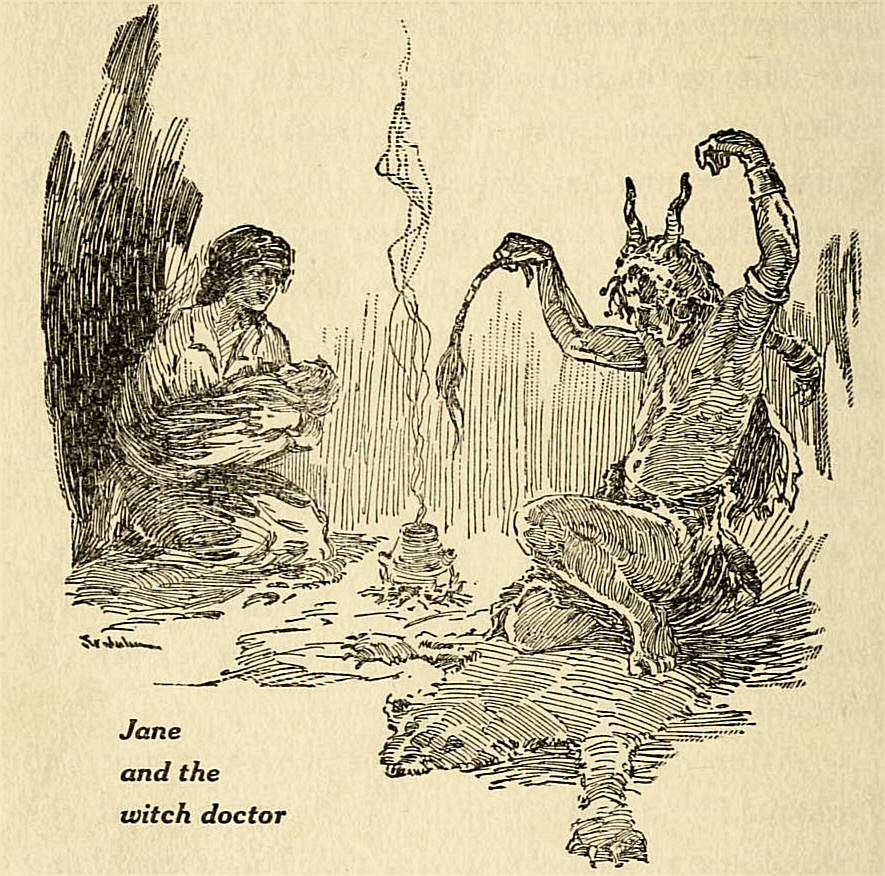


The witch doctor came and built a little fire before the infant...
Der Hexendoktor kam und machte ein kleines Feuer vor dem Kind...


Dienstag, 16. September 2014

Tarzan and the Jewels of Opar with Illustrations by James Allen St. John

Yesterday's post has shown in text illustrations by James Allen St. John. However, the artist has also created pictures for Tarzan stories that are much finer and elaborate. The compositions are often violent yet graceful, dynamic and fresh, almost like a dance. Therefore, Allen St. John is referred as "The Godfather" of modern fantasy art.
Gestern haben wir Zeichnungen von James Allen St. John gezeigt, die in den Text eingestreut waren. Der Künstler hat jedoch auch Illustrationen geschaffen, die feiner, und technisch mehr ausgefeilt sind. Die Kompositionen wirken oft gewaltätig und doch anmutig, dynamisch und frisch, fast wie eine Tanzfigur. Es ist dies einer der Gründe, warum Allen St. John als "Godfather" der modernen Fantasy-Kunst bezeichnet wird.


The color picture was used for the dust cover of the first edition.

Montag, 15. September 2014

James Allen St. John Illustrations for The Son of Tarzan by E.R. Burroughs


It isn’t necessary to present the figure of Tarzan with his savages beasts , this naked guy running and jumping from tree to tree in the well known exotic jungle settings. Long before Hal Foster began his newspaper comic strip of Tarzan in 1928, there were already several illustrator of Edgar Rice Burroughs‘ books. The one who was Burroughs‘ favorite, was James Allen St. John. He captured  the images of the writer, a combination of classicism and flights of  fancy. His illustrations inspired the next generations of fantastic artists including Roy G. Krenkel, Jeffrey Jones and Frank Frazetta.
He was born October 1, 1872 in Chicago, Illinois. Reading his biography, one recognizes that he has inherited his talent for drawing and art painting from his mother.
In 1915 he illustrated chapter headings for The Return of Tarzan by Edgar Rice Burroughs for McClurg Publishing. The dust-jacket was painted by N.C. Wyeth. In 1916 he drew the story illustrations as well as the dust-jacket cover for The Beasts of Tarzan. This was the first of many painted covers for Tarzan books, for which the artist is most renowned.
In 1917 he began to teach Painting and Illustration classes at the Art Institute of Chicago. He continued to teach for the rest of his life. In the 1920s he illustrated stories for many of the top magazines, such as Colliers, The Rotarian, and Liberty. During the years of the Great Depression he worked for Boy's World, Amazing Stories, Fantastic Adventures, Magic Carpet and Weird Tales. J. Allen St. John died at age eighty-four in Chicago on May 23, 1957.

Es ist wohl nicht nötig, hier Tarzan mit seinen wilden Tieren vorzustellen, diesen halbnackten Burschen, der in exotischen Dschungeln von Baum zu Baum springt. Lange bevor Hal Foster mit seinem Zeitungscomic von Tarzan 1928 begann, finden sich schon zahlreiche Illustratoren für Edgar Rice Burroughs Bücher. Unter ihnen war James Allen St. John der Favorit von Burroughs. Er konnte in seinen Bildern die Komposition von Klassik und den Flug der Phantasie des Schritstellers einfangen. Seine Bilder inspirierten sicher die nächste Generation von Künstlern wie Roy G. Krenkel, Jeffrey Jones und Frank Frazetta.
James Allen St. John  wurde am 1. Oktober 1872 in Chicago geboren. Liest man seine Biographie, wird klar, dass seine zeichnerische, künstlerische Begabung von seiner Mutter stammte.
Um 1915 illustrierte er die Kapitelanfänge für The Return of Tarzan by Edgar Rice Burroughs for McClurg Publishing. Der Schutzumschlag stammte von N. C. Wyeth. 1916 zeichnete er Bilder und den Schutzumschlag für The Beasts of Tarzan. Es ist der erste Schutzumschlag von vielen anderen, die folgten und durch die der Künstler bekannt wurde.
1917 begann er Malerei und Illustration am Art Institute of Chicago zu unterrichten, was er bis zu seinem Lebensende fortsetzte. 1920 illustrierte er Geschichten in bekannten Magazinen, wie Colliers, The Rotarian, und Liberty. Während der Grossen Depression arbeitete er für Boy's World, Amazing Stories, Fantastic Adventures, Magic Carpet and Weird Tales. J. Allen St. John starb 1957 im Alter von 84 Jahren in Chicago.