.

Montag, 1. Dezember 2014

Frank Frazetta: Thun'da, King of the Congo, No 1.

Frank Frazetta, painter, illustrator, and comic artist, got green light from Magazine Enterprise to create his own comic Thun'da King of the Congo in 1951. It is basically Franzetta's own version of Tarzan's world. It was publisheded 1952. Thun'da, issue 1, was the only complete comic book Frazetta ever drew. He said about it: "I came up with this Tarzan-like character who gets trapped in a lost world. They brought in Gardner Fox to write the script based on my idea and the first story in the book followed my plans pretty closely. Then the editor, Ray Krank, had Fox take everybody out ot the prehistoric setting by the end of the third story in the book and ruined the entire concept: they turned it into just another cardboard jungle comic."


Frank Frazetta, Maler, Zeichner und Comic Künstler, erhielt 1951 grünes Licht von Magazine Enterprise, um seinen eigenen Comic Thun'da King of Congo zu zeichnen. Im Grunde genommen handelt es sich dabei um Frazettas eigene Version einer Tarzan-Welt. Das erste Heft erschien 1952, und es war auch das einzige, das  Frazetta vollständig allein schuf. Er bemerkte dazu: Ich hatte die Idee einer tarzan-ähnlichen Figur, die sich in einer verlorenen Welt gefangen sieht. Sie stellten dann Gardener Fox an, den Text dazu nach meiner Idee zu schreiben. Die erste Geschichte folgte meiner Idee ziemlich genau. Als dann der Herausgeber Ray Krank, Fox veranlasste, alle Figuren aus dem praehistorischen Umfeld am Ende der dritten Geschichte zu entfernen, war mein Konzept völlig ruiniert. Sie verwandelten das Ganze einfach in einen anderen gewöhnlichen Dschungel Comic.


By printing the illustrations as coloured pictures many fine details of the original drawing are lost as can be seen by comparing the above black and white drawing to the printed page of the comic.


Samstag, 29. November 2014

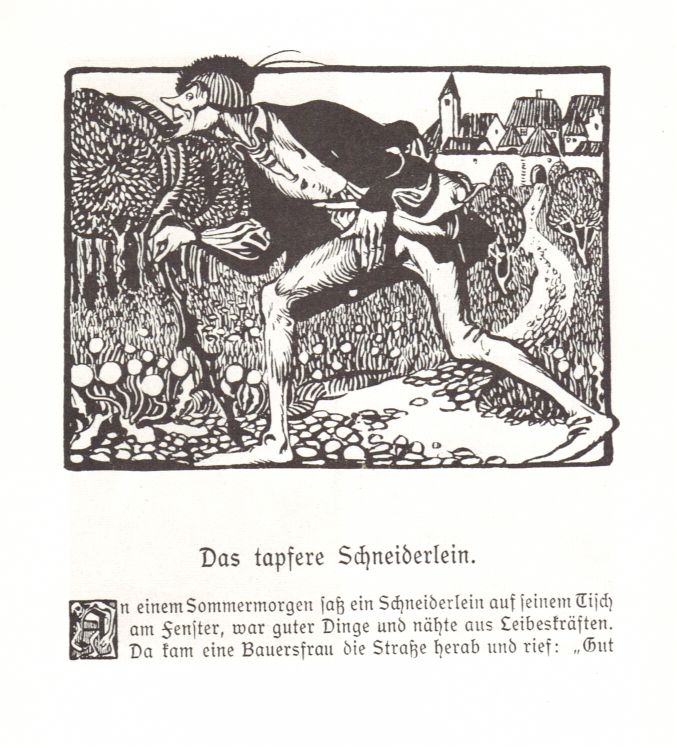
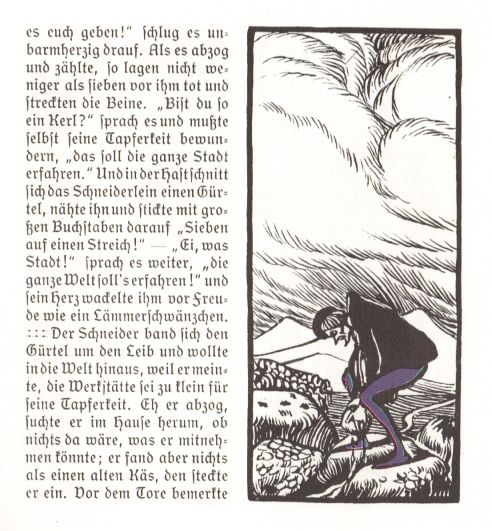
Gerlach's Jugendbücherei: Ignaz Taschners Illustrationen zu Grimms Märchen, Part 1

Ignatius (Ignaz) Taschner (1871 - 1913) war ein deutscher Bildhauer, Medailleur, Grafiker und Illustrator.
Doch seine Karriere gestaltete sich schwierig. Er arbeitete zwar eifrig: schuf Skulpturen, zeichnete, malte - ohne jedoch etwas verkaufen zu können und war 1901 von unerträglichen Kopfschmerzen geplagt. Die Zeit der Selbstzweifel und Entbehrungen endete als der Jugendstil die Welt zu erobern beginnt. Zu Zeiten der Sezession hatte Taschner einen klangvollen Namen in München, Wien und Berlin. 1903 unterrichtete Taschner als Dozent an der Königlichen Akademie in Breslau. Es war die Zeit, als er mit Ludwig Thoma Freundschaft schloss. Das Dachauer Land wurde zum verbindenden Faktor zwischen den beiden Charakteren und vieles, was Taschner hier entdeckte, fand Einzug in seine Werke und in die Illustrationen für Thomas Texte. Seine Illustrationen zeigen eine kraftvolle, holzschnittartige Bildsprache. Die subtile Farbgebung und die gleichzeitig dem Jugendstil und der Volkskunst angelehnten Formen machen seinen persönlichen Stil aus.

Ignatius (Ignaz) Taschner (1871 - 1913) was a German sculptor, commercial artist, medallist, and a illustrator. The beginning of his carrier was not brilliant. He worked hard: He created sculptures, drew, painted - but he couldn't sell anything, and during 1910 he was suffering from unbearable headaches. The time of self-doubt and privations was ending, when the Jugendstil was conquering the world. During the time of Secession Taschner's name was famous in Munich, Vienna and Berlin. 1903 he was a lecturer at the Königliche Akademie in Breslau. At this time he made friends with Ludwig Thoma. The country of Dachau became the link beween these two characters, and many things which Taschner discovered here have entered into his works and the illustrations for Thoma's writings. His illustrations show a powerful style like woodcarvings. The subtle colouring and his forms which follow the Jugendstil and the folk art are characteristic for his personal style.


The Valiant Taylor (Das tapfere Schneiderlein)


Iron Hans (Der Eisenhans)